Renaissance Broker

I designed a concept for a standalone investment app that helps beginners take their first steps while giving experienced investors fast access to portfolio management and trading tools.

  • Product designer
  • Design exercise
  • 2025

Responsibilities: research, product concept, UX/UI design, prototype

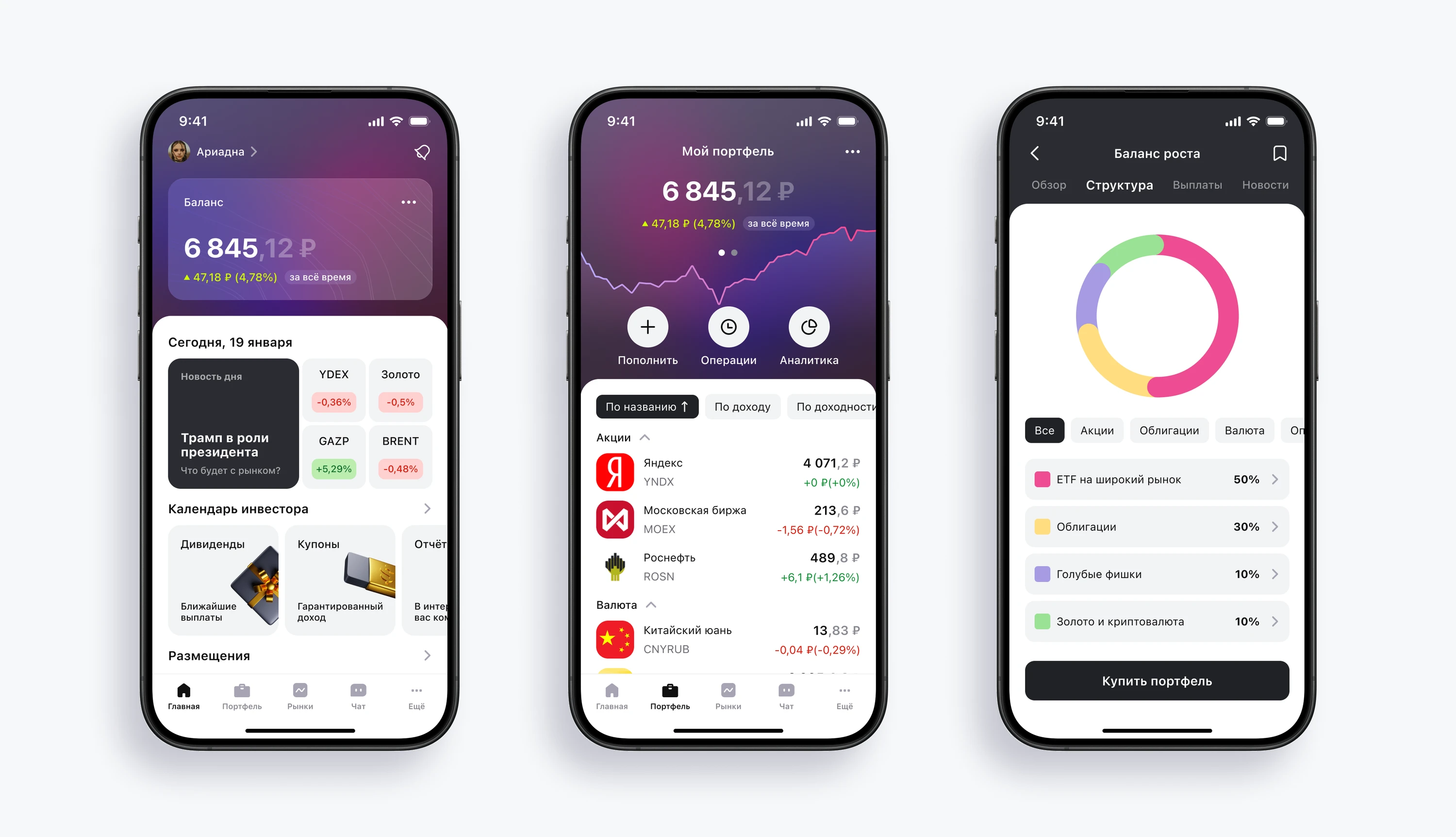
Three screens of the Renaissance Broker app

Problem

Investment features are located inside the bank's main app. The section is difficult to find and learn, and its capabilities are too limited for regular investment management.

Beginners lack a clear entry point, while experienced investors need deeper analytics and more advanced trading tools. According to the brief, fewer than 2% of the bank's customers invest in the stock market.

Challenge

Develop a concept for a standalone investment app that lowers the barrier to entry for beginners while retaining the depth experienced investors need.

Design process from current product analysis to UI kit

Research

To understand the subject area, I interviewed an active investor, studied the core investment instruments, and reviewed the bank's existing section. I then compared it with five competitors and identified the scenarios the concept needed to support.

The research findings became the basis for product hypotheses to be validated with users.

Current product analysis

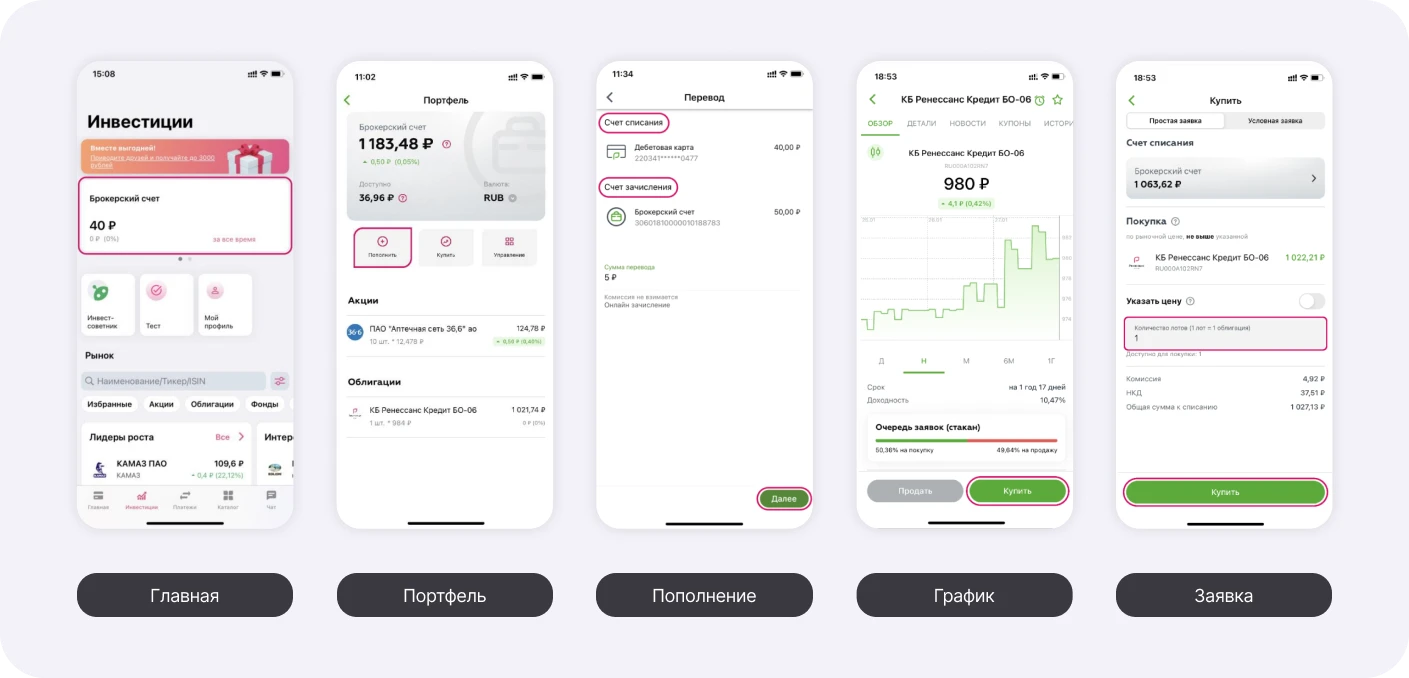
Five screens of the existing investment section
Screens of the existing section

I began by reviewing the investment section in the bank's existing app. It is difficult to discover, key actions lack emphasis, portfolio information is fragmented, and the available asset-analysis and order settings are not sufficient for regular use. This raises the barrier to entry for beginners and limits the scenarios available to experienced investors.

Problems in the current product and proposed solutions

Competitive analysis

I analyzed five competitors: Alfa Investments, T-Investments, MTS Investments, Raiffeisen Investments, and Sber Investments.

Strengths: extensive investment-management tools, educational materials, analyst recommendations, ready-made strategies for beginners, portfolio analytics with sector filters, and order history.

Weaknesses: some apps, including Raiffeisen and Sber, offer a limited selection of order types, which may not meet the needs of advanced investors.

In Alfa Investments, the available order types depend on the plan; the Pro plan unlocks additional options.

T-Investments stands out with Pulse, its built-in social network for investors.

Comparison of features across five investment apps

Key findings

Based on the interview and competitive analysis, I formulated three hypotheses:

  • Beginners need explanations and support at the moment of decision.
  • Experienced investors need analytics, multiple order types, and fast access to market data.
  • Both groups need to understand their portfolio status at a glance and reach key actions quickly.

These findings defined the app structure and the scenarios used in the next design stage.

Brand palette of the application "Renaissance Broker"

Target audience segmentation

View full segmentation
Segment A — active investors

These users tend to have significant life and professional experience, allowing them to navigate financial markets with confidence.

  • Trade regularly and actively manage their portfolio
  • Use advanced features such as analytics, market summaries, and automated trading tools
  • Follow market trends closely and often look for new investment opportunities
Segment B — growing investors

These users are actively gaining investment experience and are often in a period of career and financial growth. Their income allows them to begin investing, and future income growth may increase the amount they invest.

  • Have started investing, but are less active than Segment A
  • Are interested in learning and tools that can improve their trading strategy
  • Want to invest more and explore new opportunities and products
Segment C — potential investors

Young professionals and early-career users who are just becoming familiar with investing. Limited financial resources may delay their first investment despite strong interest in learning and market research.

  • Have registered and shown interest, but have not begun investing actively
  • Use educational sections and read analysis, but hesitate to take the first step
  • Have basic knowledge but are not ready to invest without support
Segment D — inactive users

Investing is not a priority for these users, or they temporarily lack the time to focus on it. Their financial capacity is sufficient but not always stable, which leads to irregular app use.

  • Open the app occasionally to check quotes or news, but do not use it regularly
  • May be formerly active users or people who use the app only for general information
  • Rarely use portfolio-management features
Segment X — high-income users

These users have achieved career and financial success and are looking for new ways to grow their capital. They often have a strong education and personal-finance experience but may lack in-depth investment knowledge.

Challenges and barriers:

  • Lack of specific recommendations. They understand the basics but do not know where to start or which product to choose
  • Fear of unjustified risk and possible losses due to limited hands-on experience
  • Information overload

Of the five segments, I focused on two contrasting groups: beginners and experienced investors. This made it possible to test whether one product could combine an accessible entry point with professional tools.

Beginner investor

Wants to start investing but does not know which instrument to choose, is afraid of making mistakes, and needs clear guidance.

Primary job: make a first investment and understand what is happening to the money.

Experienced investor

Regularly manages a portfolio, compares assets, and uses multiple order types.

Primary job: assess the situation quickly and complete the required action without unnecessary steps.

Hypotheses

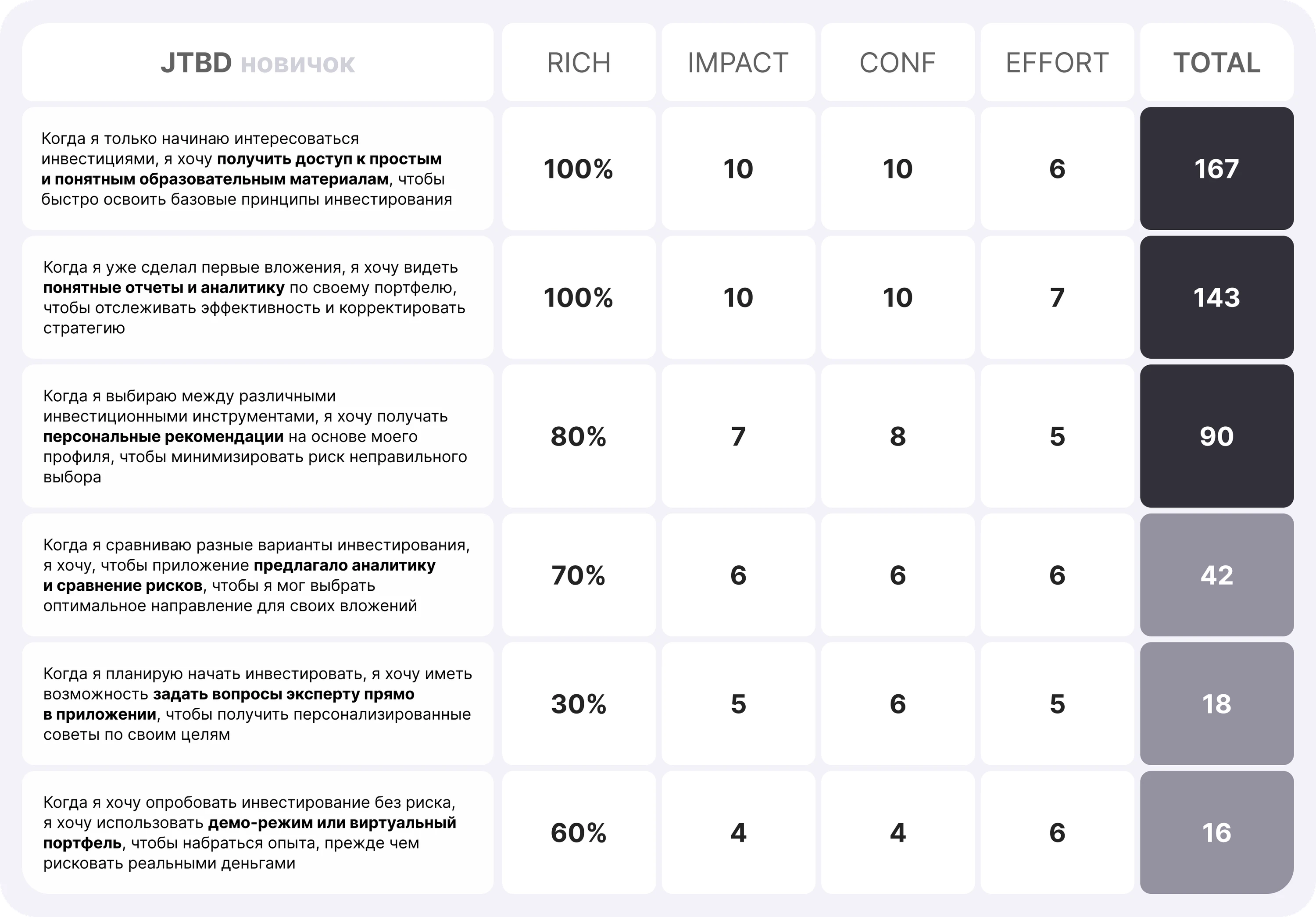
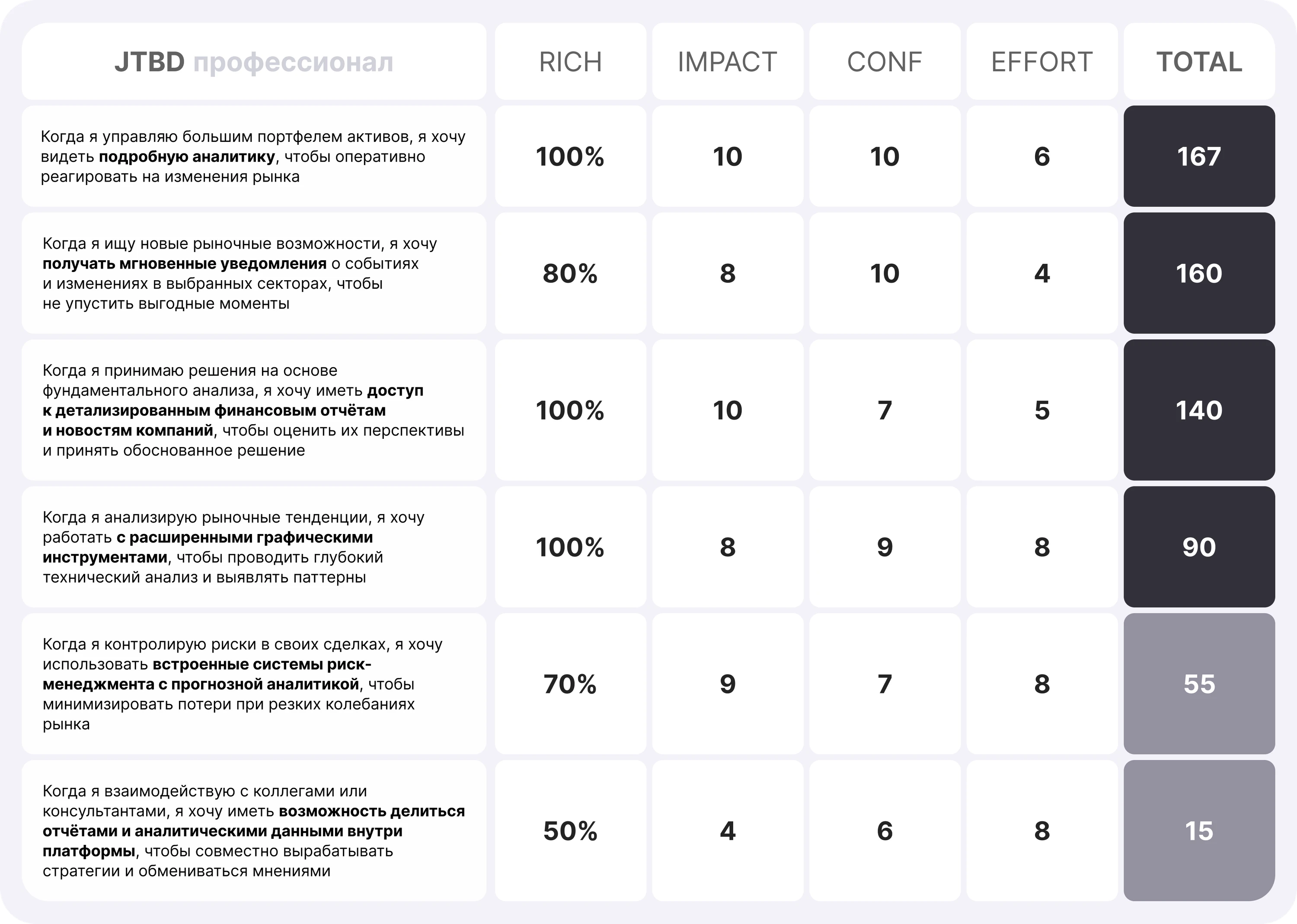
I formulated hypotheses in JTBD format and prioritized them using RICE. Because product analytics were unavailable, the prioritization was directional: I compared expected user value, confidence, and implementation effort.

JTBD Hypotheses for Beginner Investor with RICE Prioritization
JTBD Hypotheses for Professional Investors with RICE Prioritization

I focused first on the scenarios that influence product adoption and key actions:

  • Introducing beginners to the app's capabilities.
  • Choosing a strategy or asset.
  • Analyzing a portfolio.

Metrics

After launch, I would measure not only overall activity but also completion of the key user journeys.

  • Conversion from completed onboarding to first purchase.
  • Time to first investment.
  • Share of users who return to manage their portfolio.
  • Repeat trades within 30 days.
  • Task-completion rate for beginners and experienced investors.
  • CES (Customer Effort Score) for key journeys.

Primary metric — activation: the share of new users who start onboarding and make their first investment within seven days. It shows whether the product helps people move from learning about the available instruments to completing the first target action.

How I would validate the concept before launch. For this design exercise, the concept could be tested with a clickable prototype in moderated sessions with beginner and experienced investors. Participants would complete onboarding, select an asset or strategy, and place a test order. For each journey, I would record unassisted completion, time on task, critical errors, and CES. This would not prove an impact on business metrics, but it would show whether the proposed logic is understandable before development.

Mockups

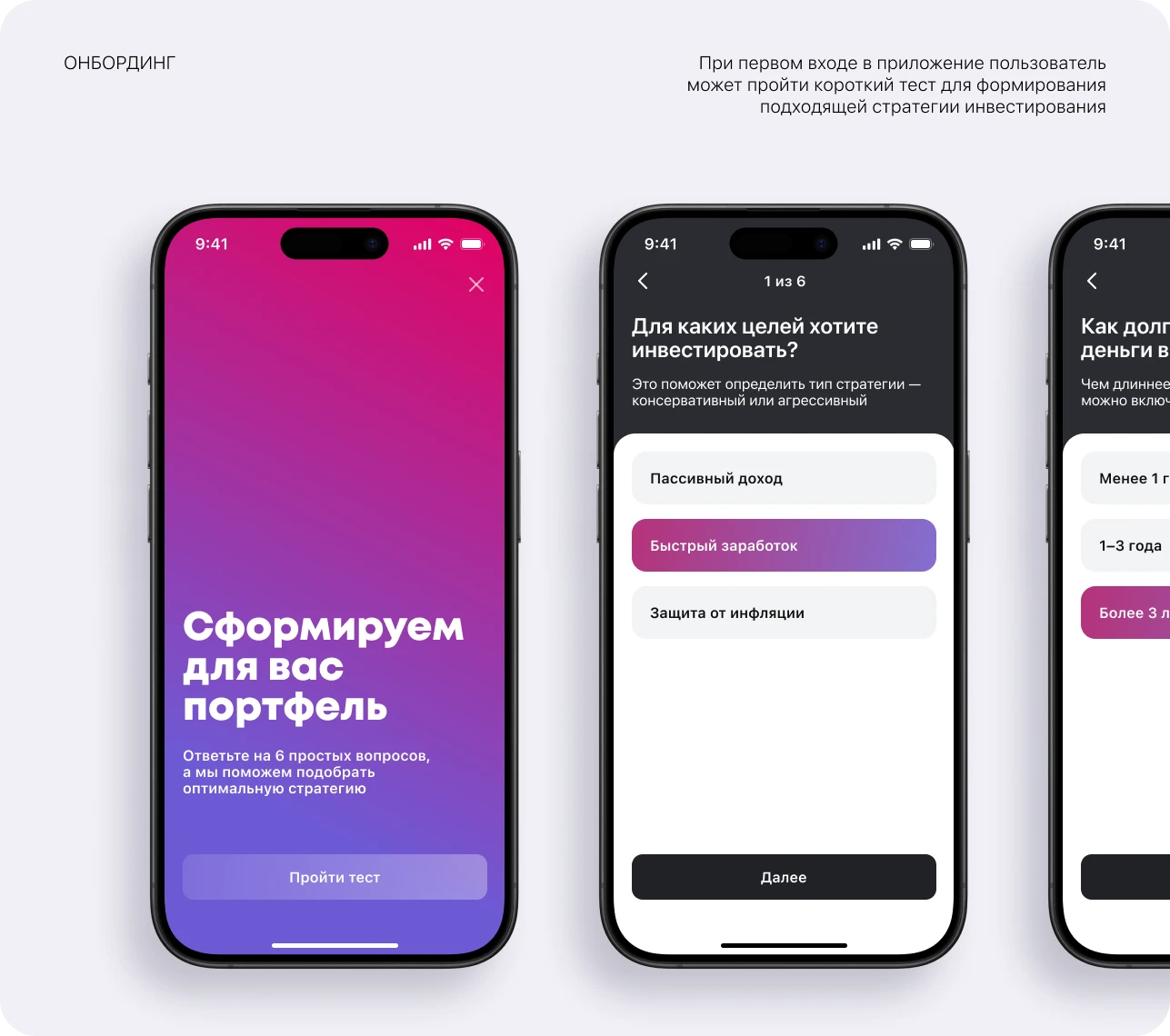

Goal. Help a beginner get started.

Problem. Without prior experience, it is difficult to know where to begin or which instrument to choose, while unfamiliar terminology increases the fear of making a mistake.

Solution. Onboarding introduces the app's core capabilities, while ready-made strategies help users move from exploring the product to considering a first investment.

Onboarding screens
Animated screens of investment strategies

Goal. Simplify everyday work with the market.

Problem. To make decisions, users need to assess their portfolio, see changes, and compare instruments quickly without moving through many screens.

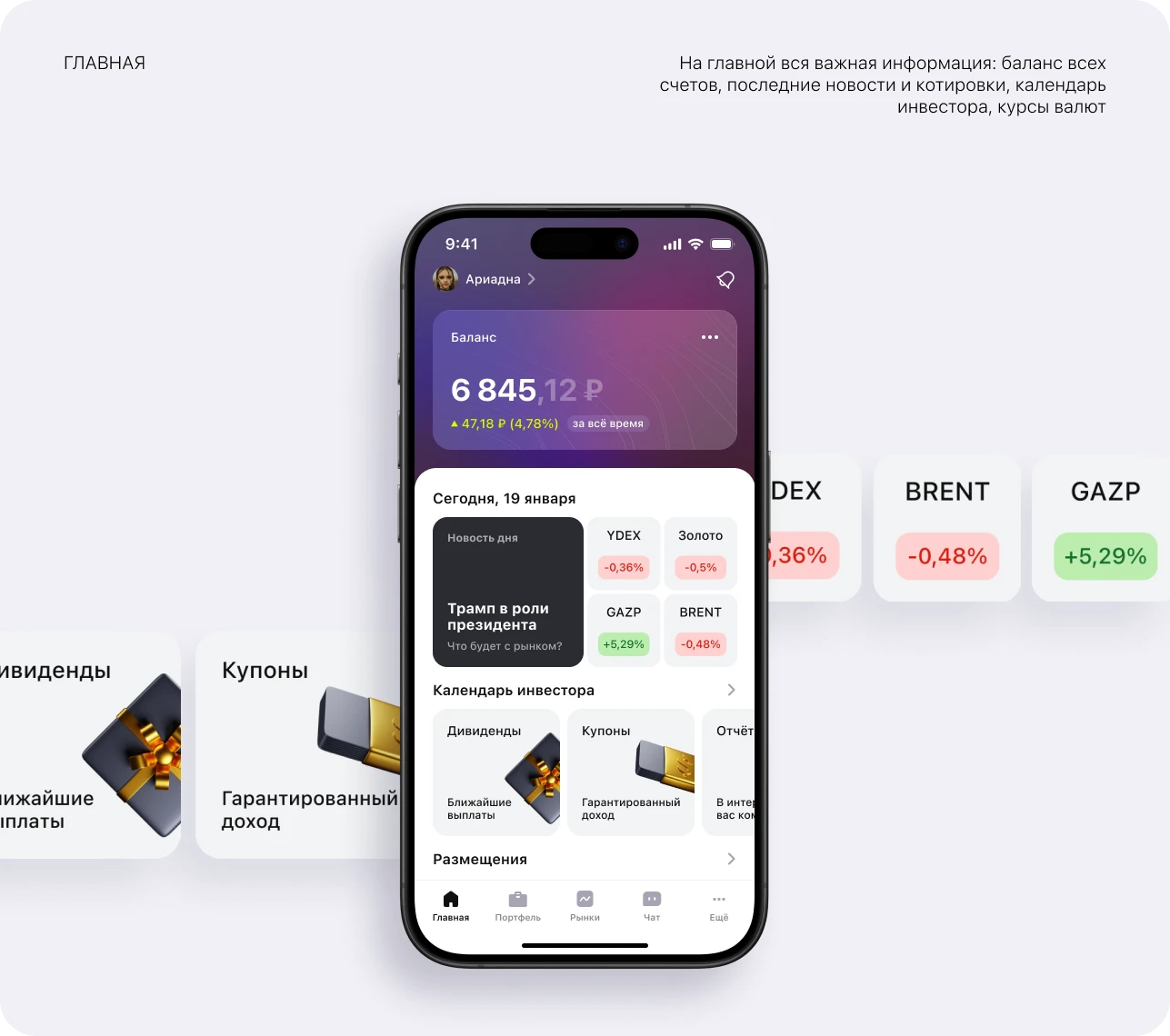
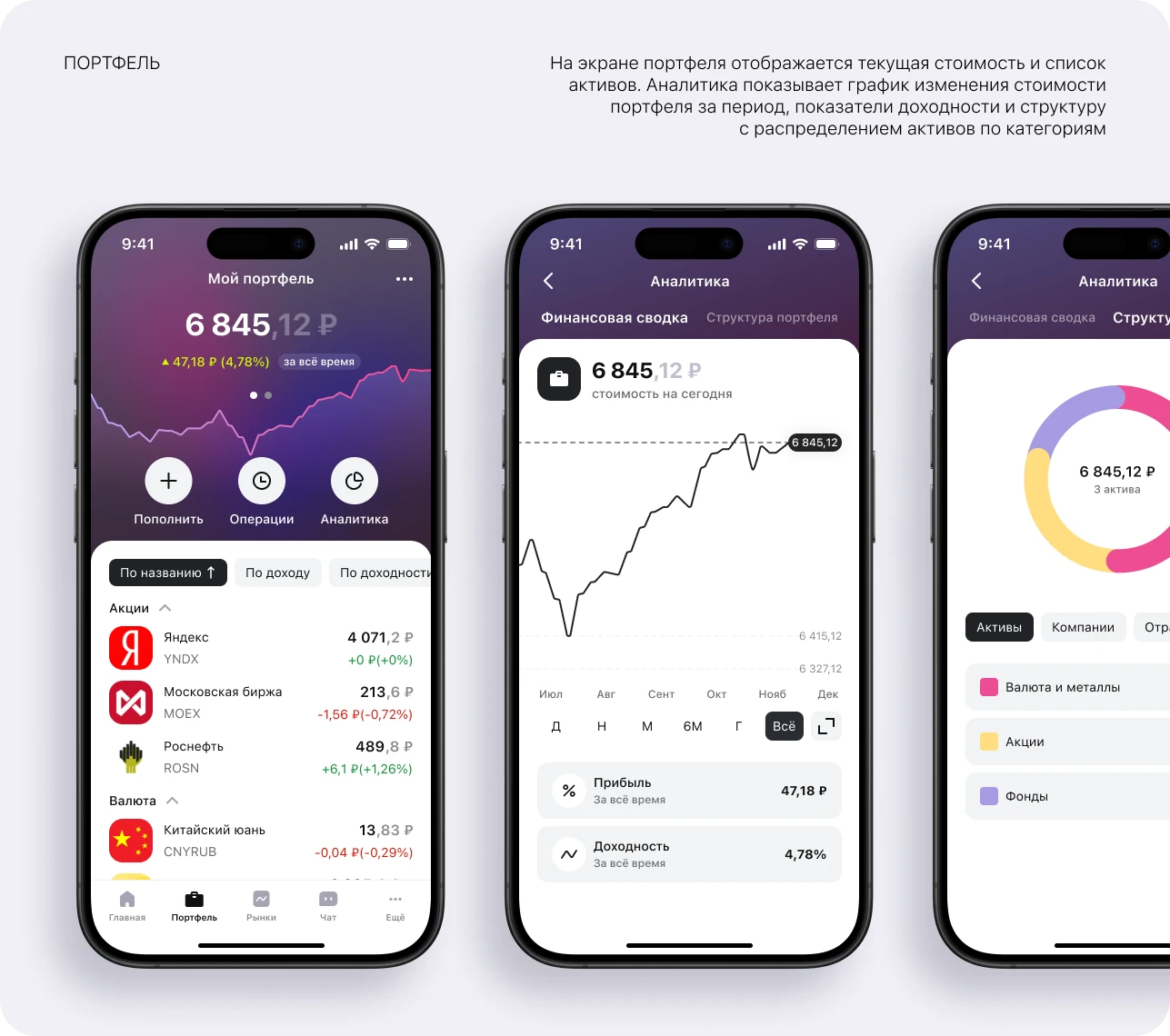
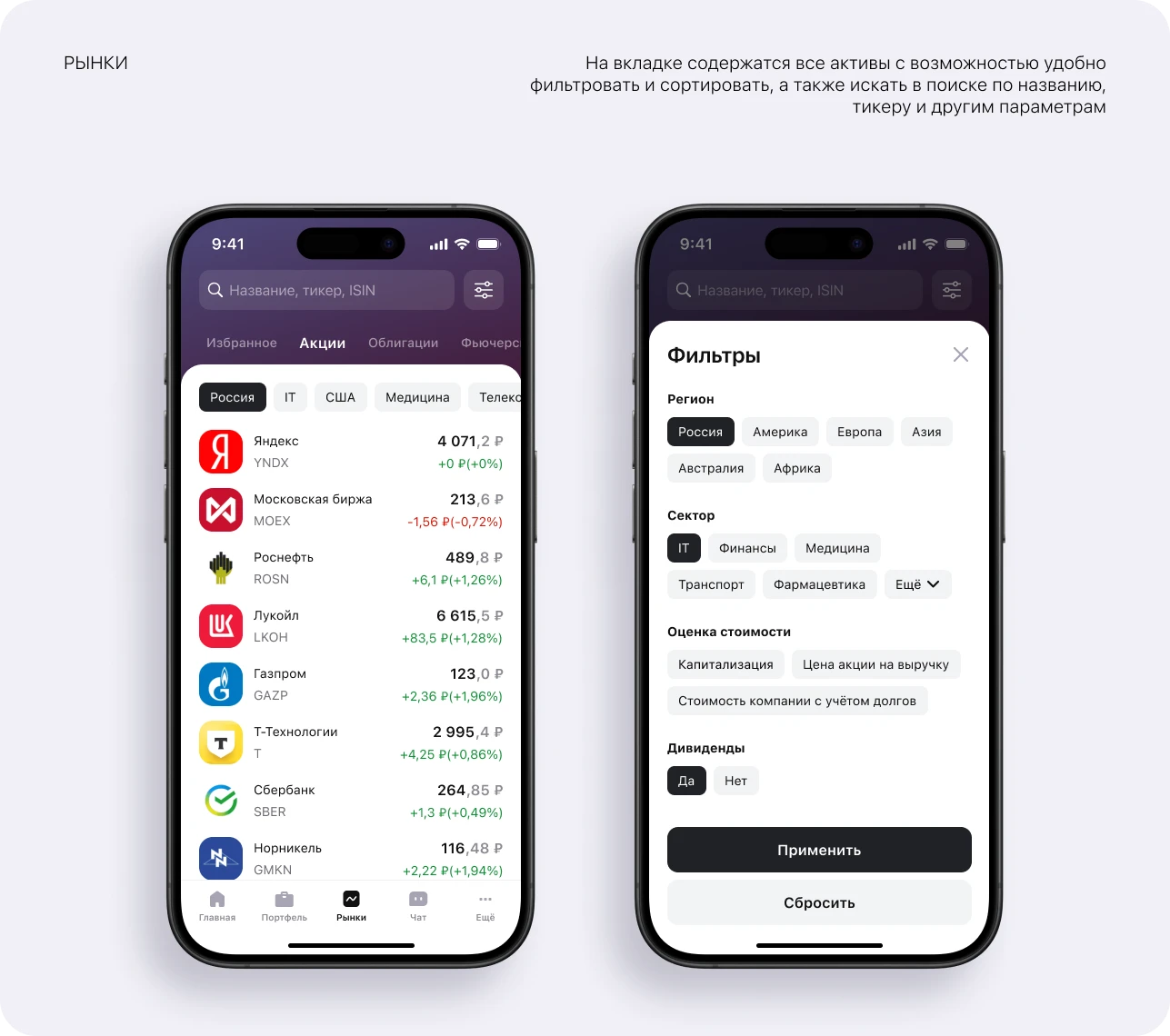
Solution. The home screen combines a portfolio overview with quick actions, the portfolio section provides analytics, and the markets section supports asset comparison and filtering.

Main screen of the application
Portfolio screens and analytics
Market and filter screens

Goal. Preserve depth for experienced investors.

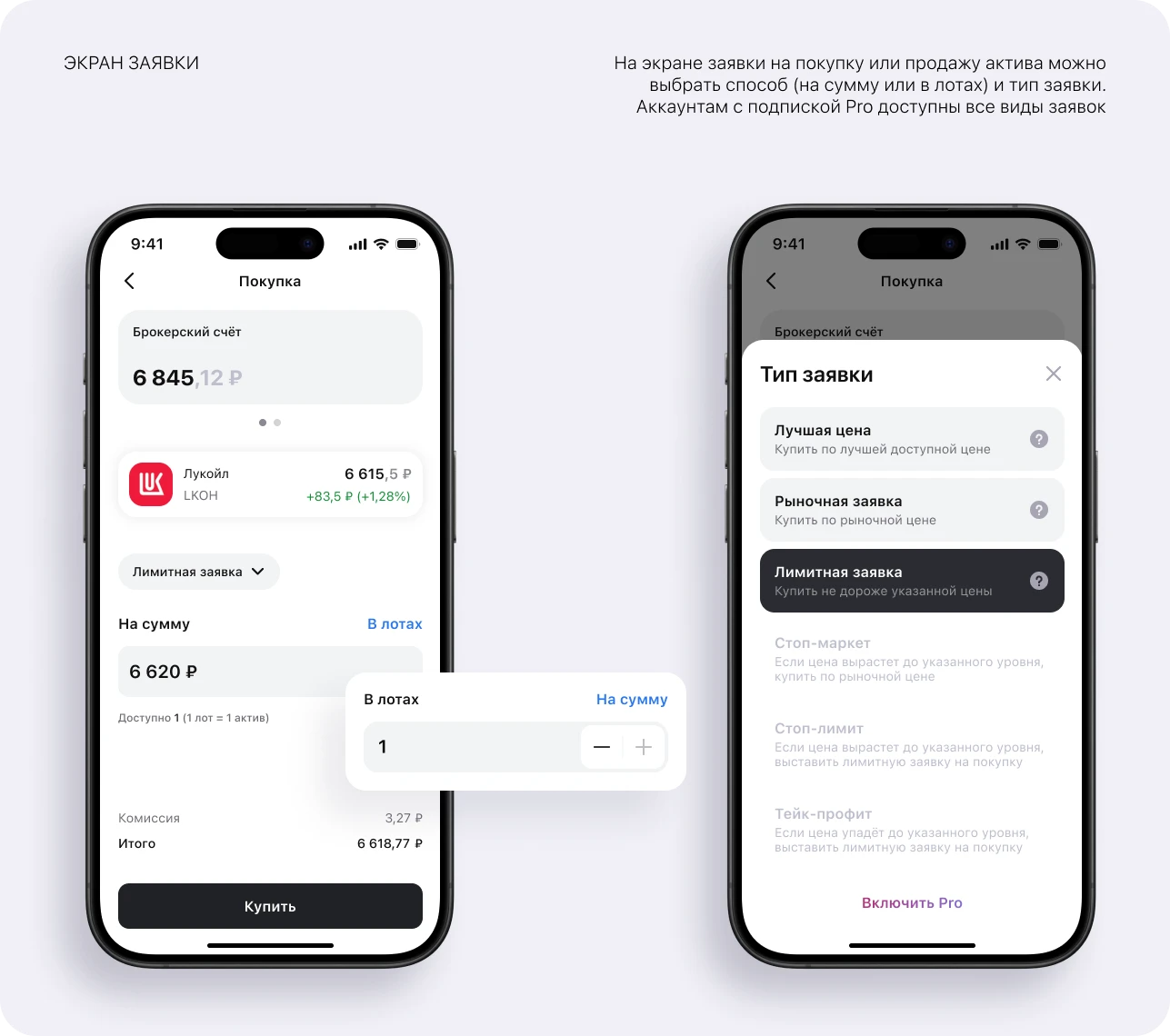
Problem. Simplifying the interface could remove the data and controls experienced investors need to make decisions and place trades.


Solution. The asset card presents detailed price movement and market data, while the purchase flow supports order-type selection and the key trade parameters.

Animated asset card
Screens of the application for the purchase of an asset

Outcomes

I developed a concept for a standalone investment app and a prototype of the key journeys for two audiences, from product introduction and first investment to portfolio analysis and order setup.

  • For beginners, I designed onboarding, educational materials, and ready-made strategies that simplify the path to a first investment.
  • For experienced investors, I retained portfolio analytics, detailed asset data, and advanced order settings.
  • I formulated product hypotheses, defined metrics, and outlined a way to validate the concept before development.
The concept shows how one product can combine an accessible entry point for beginners with the depth experienced investors need.