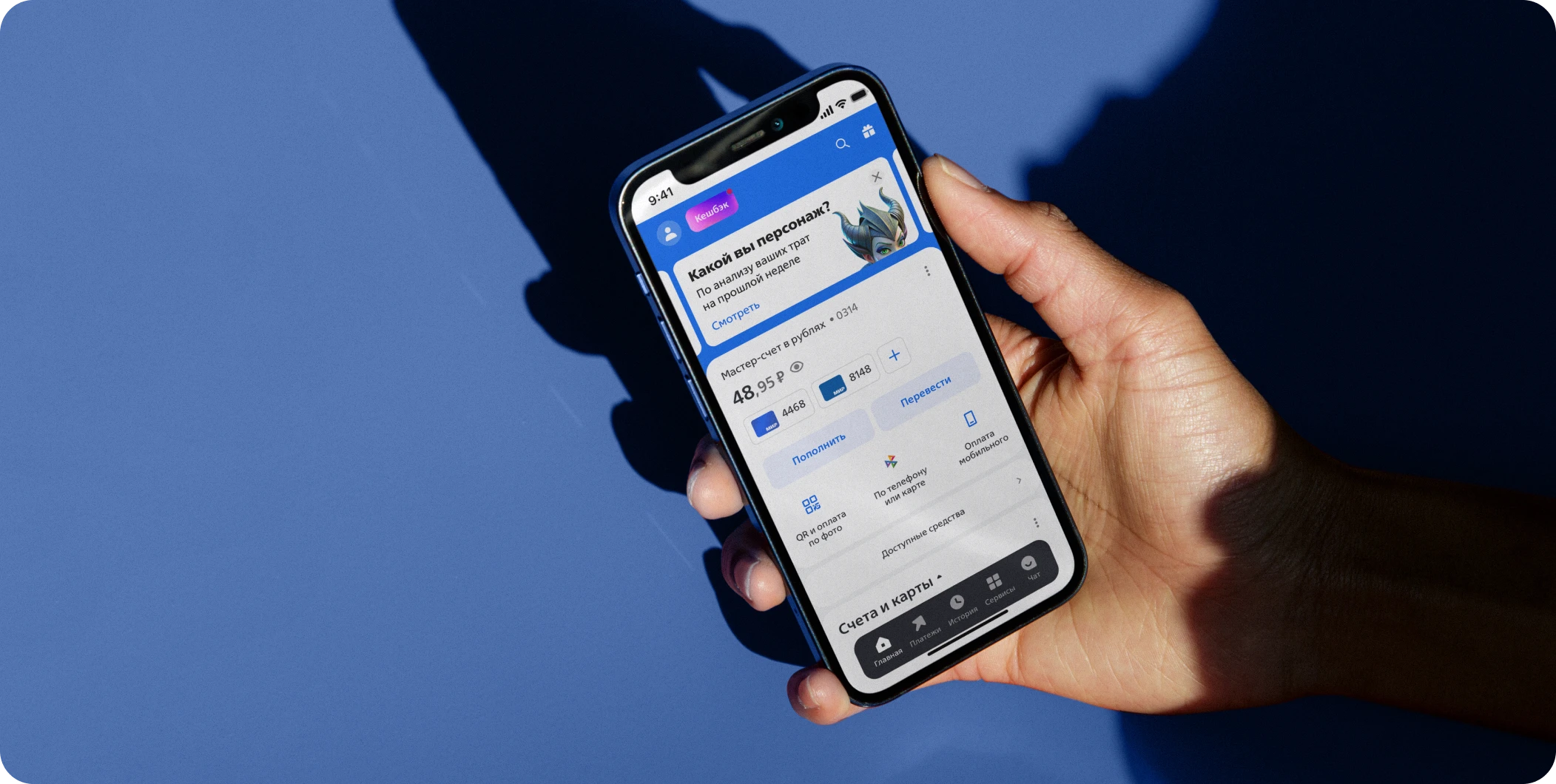
I designed two game mechanics for a banking app: an educational credit card quest and a weekly financial character. The mechanics help users understand banking products and return to spending analytics.
Financial tasks in banking apps often feel routine, while motivation to manage personal finances remains low.
Users rarely engage in financial planning or expense tracking, postpone saving, and overlook useful app features. This reduces loyalty and the frequency of interaction with the bank.
Objective
Develop a gamification concept that helps users engage more consciously with financial products and encourages repeated use of helpful app features while preserving transparency and safety in banking journeys.
Research
Audience
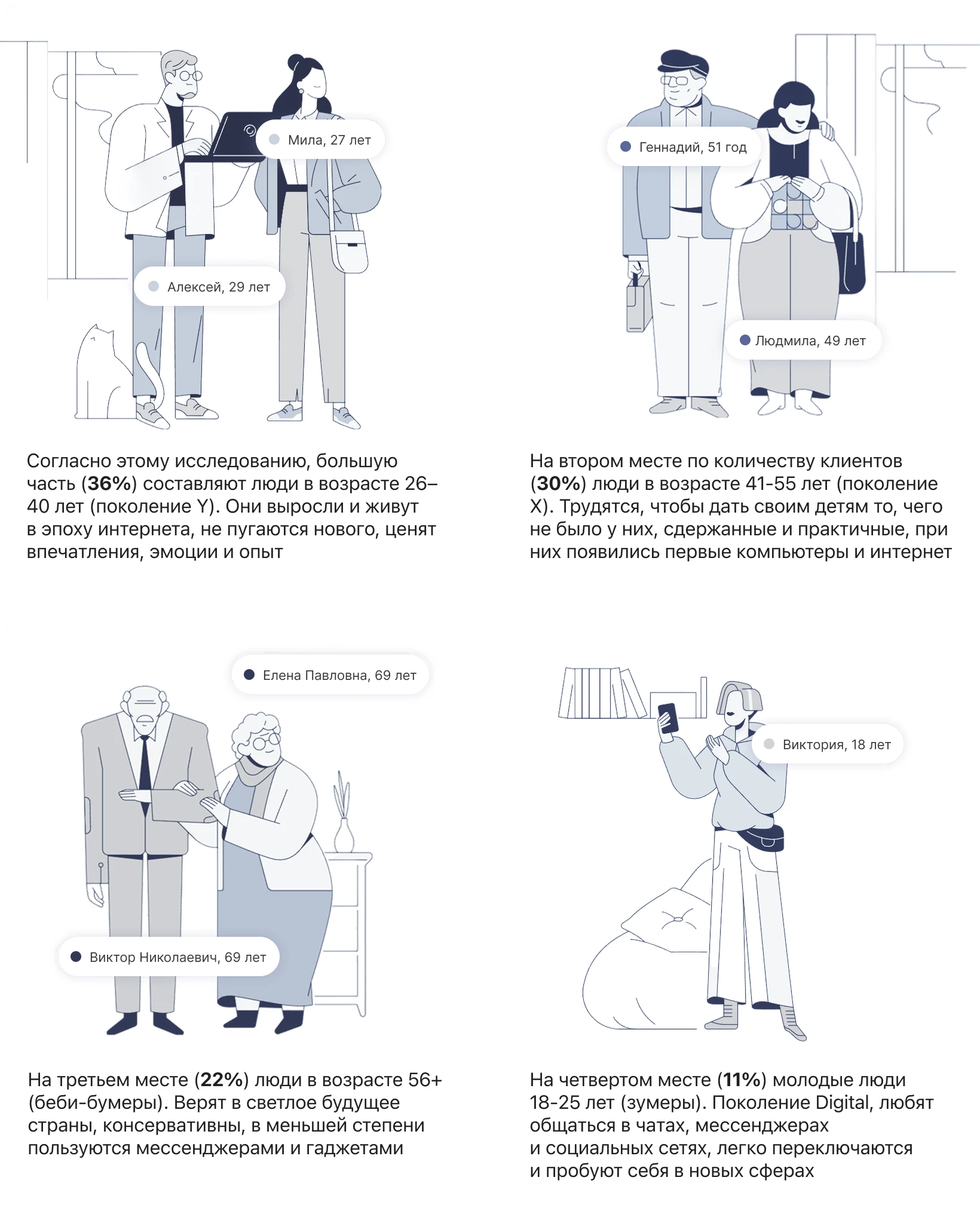
To identify the banking journeys where gamification could provide value, I reviewed public data about VTB’s audience, segmented users, and analyzed examples of game mechanics in banking and other digital products.
Because this was a design challenge, I treated the research findings as product hypotheses that would need to be validated with users.
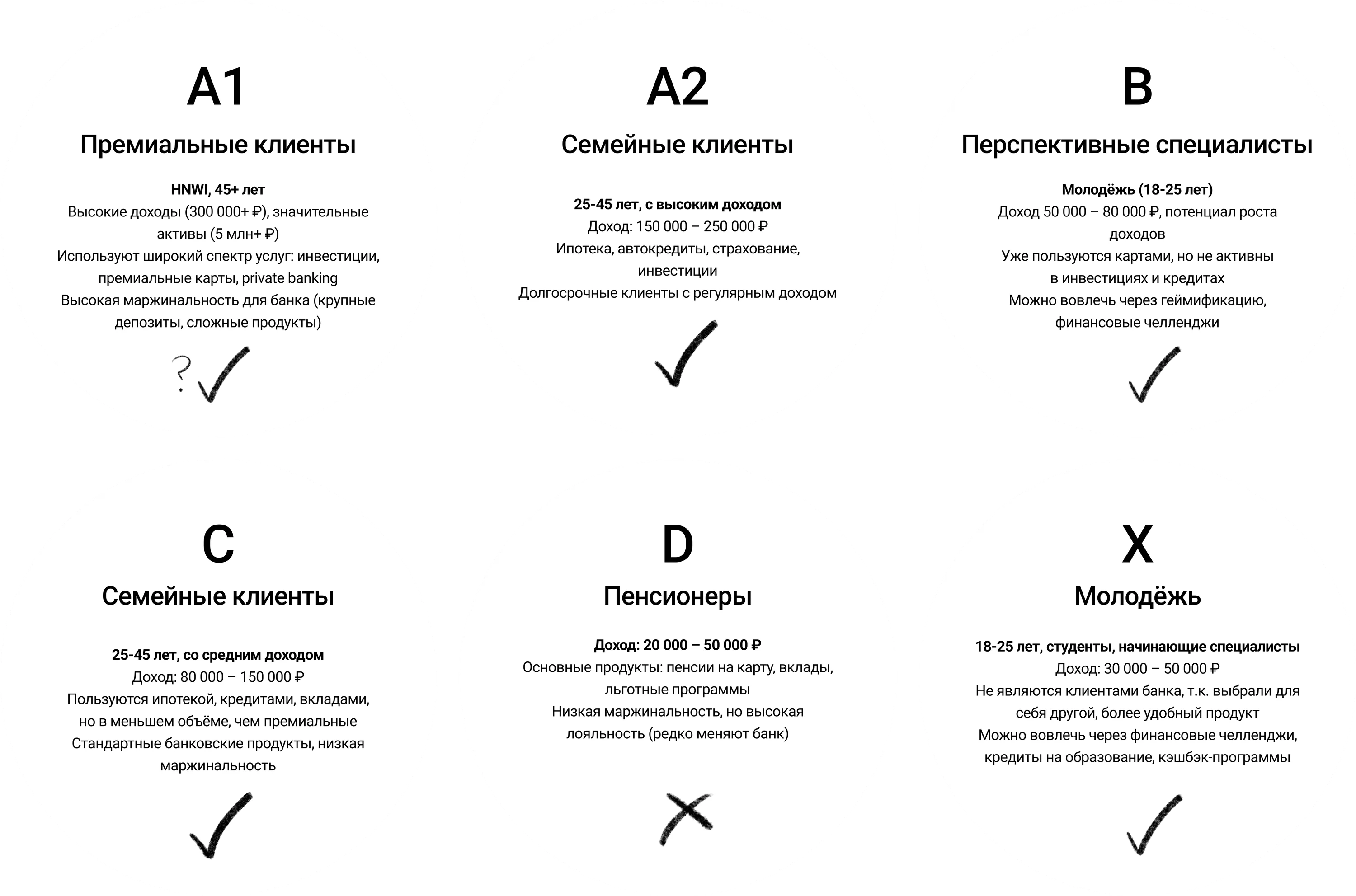
View the full segmentation
Age alone is not enough to define a target audience: income, lifestyle and values, employment, and other factors also matter. I therefore created an ABCDX segmentation and identified the groups that gamification could target (✓).
High-income users (segment A1) are more likely to be interested in investments, insurance products, and tax optimization. Personalized challenges, such as improving investment returns, and status-based rewards could appeal to them.
People aged 25–45 with middle or high incomes (segments A2 and C) are active users of banking services who are interested in managing their finances but have limited time. Missions tied to financial goals, progress visualization, and social mechanics may appeal to them.
Young adults aged 18–25 with low or middle incomes (segments B and X) are often just starting their careers and may struggle with saving and financial planning. Small-savings challenges and rewards for recurring payments or helpful app actions may appeal to them.
From these segments, I focused on two behavioral groups:
New credit card holders
They find it difficult to understand the product’s terms and how to use it safely.
Active mobile banking users
They want a clearer understanding of their spending patterns.
Competitive analysis
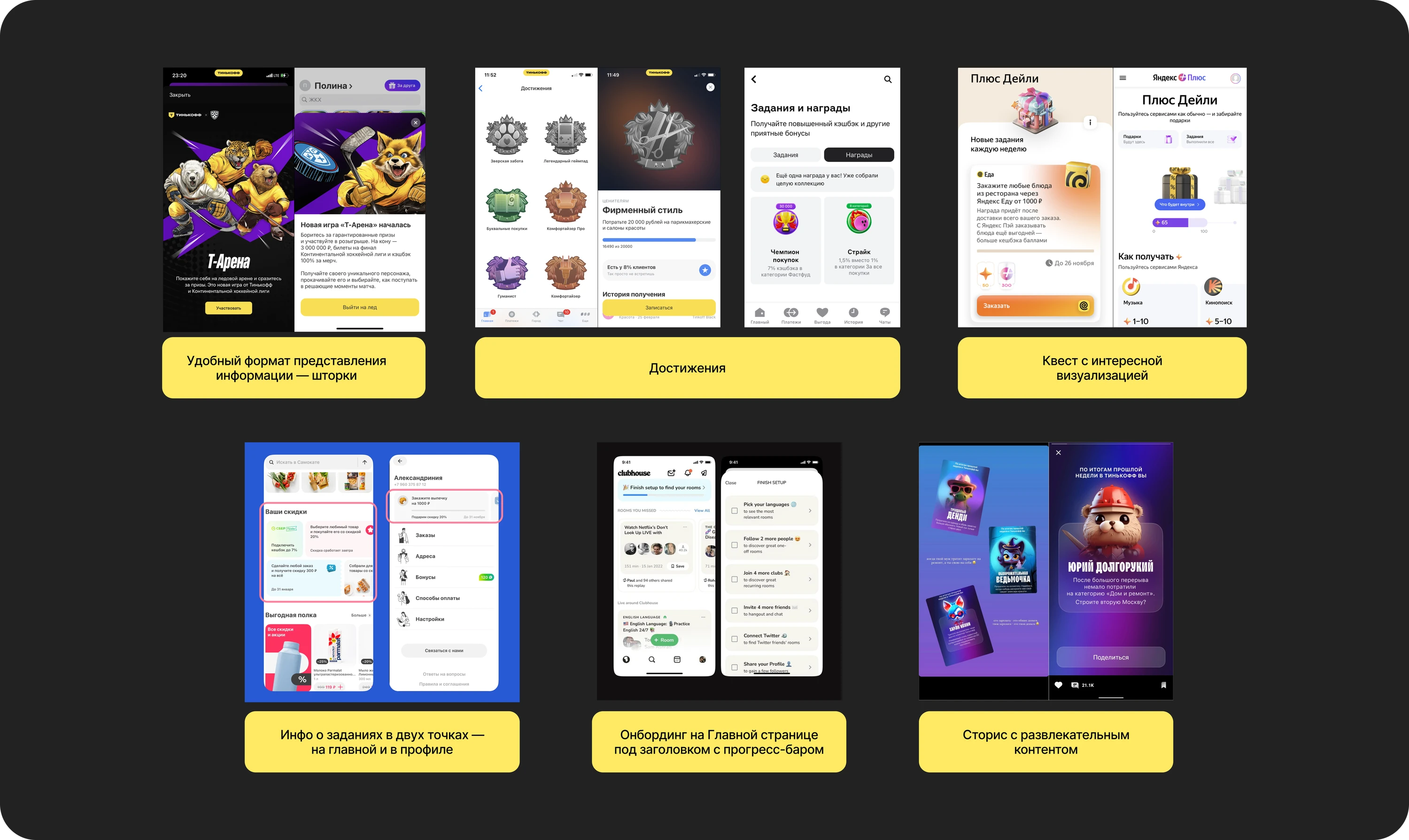
For the analysis, I studied a T-Bank gamification case study and examples from the Gamification Now library. I compared the visibility of the entry point, task difficulty, clarity of the rules, value of the reward, and how closely each mechanic supported the core product journey. This led to four principles:
1
Tasks should be simple
2
Rewards should provide real value
3
The value should be clear immediately
4
The entry point should be easy to find
Examples included in the comparative analysisBenchmarking
I evaluated potential mechanics against four criteria: value for the user, value for the bank, opportunities for recurring engagement, and the risk of negatively affecting financial behavior.
I selected two mechanics that address different needs: a quest that helps users understand a complex banking product and financial characters that encourage them to revisit their spending analytics regularly.
Credit card quest
Problem. Users do not always understand how the grace period works, how the minimum payment is calculated, or when fees apply.
Hypothesis. If users learn about a credit card through a sequence of tasks with a clear reward, they will understand the product faster and use it with greater confidence.
Solution. The quest suggests safe actions: review the card terms, set a limit and payment reminder, make a planned purchase, and repay the balance on time.
Value for the bank. The quest could increase the share of customers who understand the card terms, enable helpful settings, and use credit responsibly. This may reduce support requests and the risk of overdue debt.
Safety principle. The mechanic does not encourage users to increase their debt or make unplanned purchases.
Financial characters
Problem. Spending analytics often feel complex and impersonal, so users rarely return to them.
Hypothesis. Presenting the week’s results as an expressive visual character could help users notice patterns in their financial behavior.
Solution. The character is generated from the user’s spending mix and accompanied by a neutral explanation that avoids judgment or pressure to make new purchases.
Value for the bank. The mechanic could increase repeat visits to spending analytics and gently guide users toward setting a budget or financial goal. Over time, it may support retention and strengthen the app’s role as the user’s primary financial management tool.
Privacy principle. Users can share only the character image, without amounts, spending categories, or any other financial information.
3D illustrations — Recraft + ChatGPT
Metrics
Each mechanic should be evaluated separately. I would not treat time spent in the app as a standalone success metric: target actions and the absence of negative consequences matter more.
Credit card quest
Share of users who complete the quest.
Share of users who correctly answer questions about the card terms.
Share of users who complete the journey without hints.
Share of users who enable a payment reminder.
Support requests per 1,000 quest participants.
Financial characters
Primary metric: share of users who open the spending breakdown after receiving a character.
Share of users who return to their weekly spending analytics.
Conversion to setting a budget or financial goal.
Share of users who voluntarily share their character.
Guardrail metrics
Increase in overdue debt.
Increase in unplanned spending.
Complaints about intrusive mechanics.
Users disabling the mechanic.
User concerns about privacy.
Outcome
I developed two game-mechanic concepts and worked through their key journeys. The quest teaches users how to use a credit card safely, while financial characters make spending analytics clearer and more engaging.
As a next step, I would ask users to find each mechanic, work out its rules independently, complete a task, and explain how the reward is earned. For financial characters, I would also test whether the description feels clear and neutral and whether the character motivates users to open their spending analytics.
Unless expressly stated otherwise, the texts, structure and design of the site, graphics, illustrations, images and other materials created by me are subject to copyright.
Copying, reproduction, modification, publication, distribution, placement on other resources and other use of these materials for commercial or non-commercial purposes without prior written permission is not allowed.
Trademarks, logos, company names and materials of third parties belong to the respective copyright holders and are presented on the site exclusively as part of a portfolio.